GPU Inference Economics: Self-Hosted Server vs Per-Token API Pricing in 2026
Every AI builder eventually runs the same spreadsheet: keep paying per token, or rent a server and stop counting. In 2026 the honest answer is that it depends on exactly one variable people forget to model, which is utilization. This article walks the real published numbers from both sides of that decision and shows you the crossover arithmetic, so the choice stops being a vibe and starts being a calculation you can defend in a budget meeting.
What per-token pricing actually costs now
Open-weight model APIs got genuinely cheap. Azure AI Foundry's published 2026 price sheet lists DeepSeek V3 at $1.14 per million input and $4.56 per million output tokens, V3.2 at $0.58 in and $1.68 out, R1 at $1.35/$5.40, and DeepSeek-V4 Flash at $0.19/$0.51. Third-party hosts price the same V3 weights lower on output: DeepInfra lists $0.85 in and $0.90 out. Prompt caching changes the input side again, with cached input running about $0.014 per million tokens on DeepSeek's own tier, roughly 90 percent off standard input.
The structural property: you pay for nothing you do not use. Zero traffic costs zero. A viral week costs real money but nothing breaks. And the marginal price of the next model generation is also zero, because someone else buys the B200s. A caveat worth internalizing: output tokens cost several times input tokens on every provider, so ragged chat traffic and verbose agent loops are the expensive shape, while long-context, short-answer workloads are the cheap one. Model your input-to-output ratio before comparing any rates.
What a self-hosted GPU actually costs
On the rental side, marketplace trackers in September 2026 showed RTX 4090 instances from about $0.25 to $0.40 per GPU hour, H100 SXM listings around $2.69 to $3.29 per hour, and cost-sheet dedicated hosts quoting a single 4090 server near $139 per month against roughly $1,134 per month for a dedicated H100. Those flat monthly numbers already absorb power, since one 4090 running 24/7 draws on the order of 500 kWh per month, and a datacenter on long-term contracts pays around $0.05 per kWh.
Convert any dedicated rental to an hourly number by dividing by 730. A $139 4090 box is about $0.19 per hour, competitive with marketplace spot rates but with hardware nobody else touches, no egress metering worries, and a machine you can leave warming up overnight. Marketplace hourly rates, though, carry fine print that flat rentals do not: availability can evaporate mid-experiment, egress is metered by several hosts, and shared hardware means your latency floor belongs to someone else's batch job.
The crossover, done properly
Now connect the two columns. A 24 GB card running a quantized mid-size model can serve maybe 20 to 40 tokens per second per stream, and several streams at once with a batching server. Say your stack consumes 30 million output tokens a month. At DeepSeek V3.2 API output rates that is around $50. At the same model class self-hosted, those 30 million tokens at realistic batch throughput might occupy your $139 server for a few hours a day. Same workload, the API is cheaper. The self-hosted box wins when the token count climbs toward hundreds of millions per month, or when batching and caching shrink the API column.
Write down your break-even as tokens per month, not as an opinion. If your utilization would sit below roughly a third, the per-token bill is buying you the right to not think about GPUs, which has value too.
The non-monetary line items
Per-token pricing includes things nobody invoices you for: horizontal scale during spikes, retries handled by the provider's fleet, new model access the day they ship, and prompt caching infrastructure. Self-hosting hands all of that to you, plus quantization experiments, KV cache tuning, batch scheduling, and the boring parts like firmware updates, disk failures, and the one bad Friday when the box needs you at 2 AM.
Data sovereignty, latency floors, and provider rate limits are the three cases where self-hosting wins even on a worse spreadsheet. If your compliance story requires weights and prompts to never leave a server you control, the API column closes. For everyone else, treat the crossover as a quarterly review, because both sides of it have moved twice in the last year. There is also a fourth term nobody invoices: optionality. A rented dedicated server can be repurposed the moment the model landscape shifts, and an API account can be repurposed the same afternoon. The spreadsheet should include how often you expect to be wrong about your workload.
Neither side is universally cheaper. APIs win low and spiky volume; dedicated GPUs win sustained, high-utilization inference, and the gap between them is a number you can compute this afternoon. If the math points at owning the box without owning the electricity bill, renting predictable GPU compute by the month is how you get dedicated hardware without a colo contract.
Gear we recommend for AI workloads

GIGABYTE GeForce RTX 5070 WINDFORCE OC SFF 12G Graphics Card, 12GB 192-bit GDDR7, PCIe 5.0, WINDFORCE Cooling
Top-rated on Amazon
View on Amazon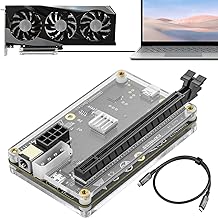
PCIE 3.0 x16 22Gbps eGPU DOCK, Thunderbolt 4 cable, compatible with external GPU NVIDIA AMD Graphics Card for
Top-rated on Amazon
View on Amazon
Lenovo ThinkStation P2 Gen 2 Workstation Desktop | Intel Core Ultra 7 265K Processor | Massive 128GB DDR5 RAM
Top-rated on Amazon
View on AmazonAs an Amazon Associate we earn from qualifying purchases.